
Imposter Syndrome in Leaders and Entrepreneurs from an IFS Lens: Healing the Parts Beneath the Pressure
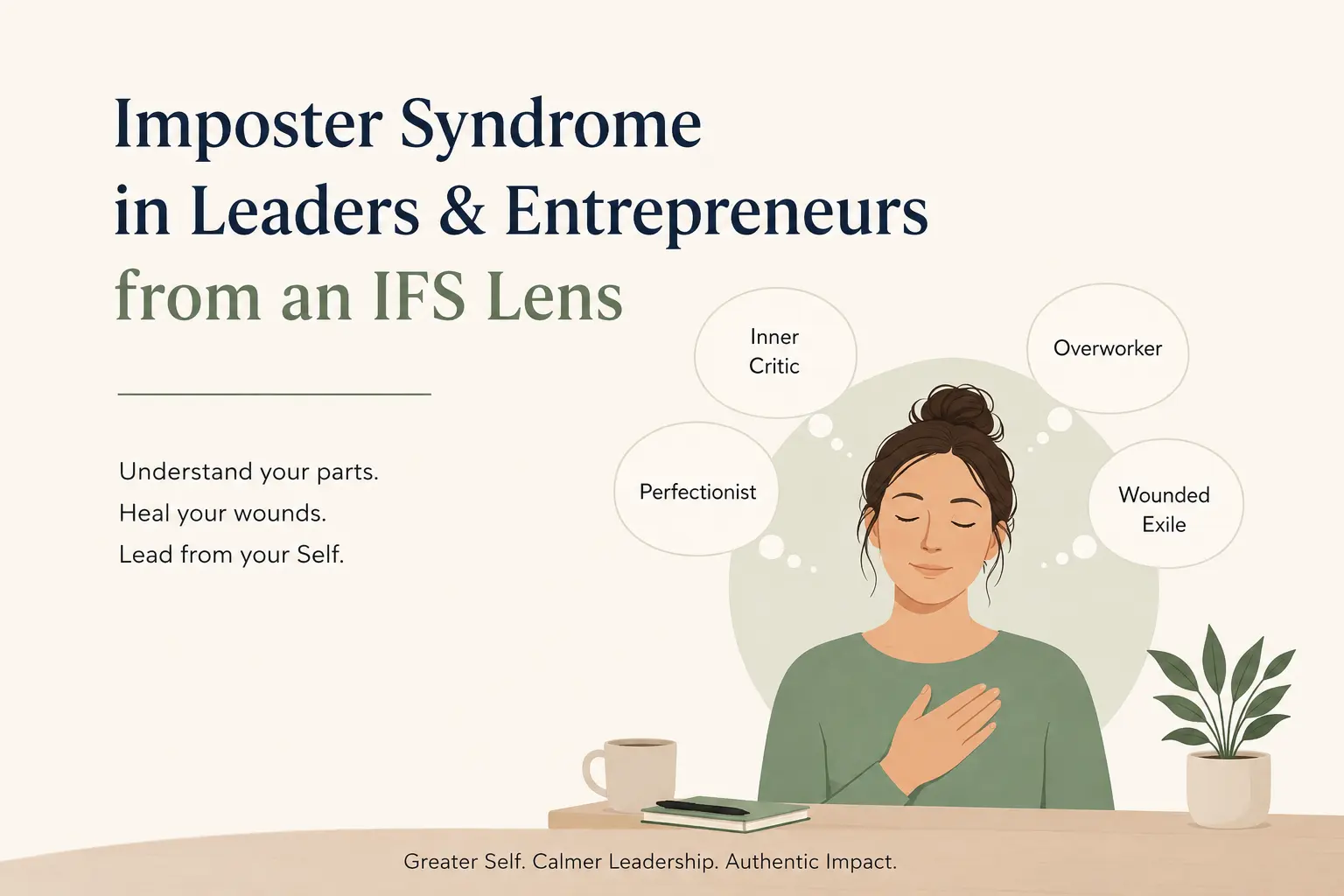
From years of working with individuals who have learned that it is safest to be a perfectionist, I’ve been able to observe and learn the ways in which imposter syndrome can become crippling as well as how to work with it in order to move towards healing.
Many leaders and entrepreneurs appear confident on the outside while privately carrying deep-seeded feelings of inadequacy. They may lead teams, launch businesses, speak publicly, or make high-level decisions, yet internally they wrestle with the persistent fear that they are not truly capable, qualified, or that their success won’t last.
This experience is often referred to as imposter syndrome. Traditionally, it is understood as a pattern of self-doubt that causes people to question their achievements despite evidence of competence. For many individuals this definition doesn’t quite capture the sensation or the nuances of imposter syndrome.
That’s where Internal Family Systems (IFS) comes in. From an Internal Family Systems lens, imposter syndrome becomes something much more complex. Rather than seeing self-doubt as a flaw to eliminate, IFS helps us understand it as a protective response arising from different “parts” within us that are trying to keep us safe.
For leaders and entrepreneurs, this perspective can be deeply transformative. Instead of battling the inner critic or trying to force confidence through “fake it till you make it” strategies, IFS invites curiosity about the internal system driving perfectionism, burnout, fear of visibility, ego, hyper-independence and chronic overachievement.
At the heart of IFS is the idea that the mind is naturally made up of different subpersonalities, or “parts,” each with its own role, fears, and motivations. These parts are not pathological. They are adaptive responses developed over time, often in reaction to emotional wounds, relational experiences, or environments where achievement became tied to safety, belonging, or worthiness.
Richard Schwartz, the creator of IFS, explains that beneath all these parts exists the “Self”—a grounded, compassionate inner leader capable of calmness, clarity, courage, and connection. When leaders operate primarily from Self-energy, they tend to lead with authenticity and emotional balance rather than fear and reactivity. This is the goal.
However, entrepreneurship and leadership roles frequently activate protective parts that pull us away from Self-energy. The higher the visibility, responsibility, and uncertainty or risk, the more likely these parts are to emerge.
One of the most common protective parts in leaders is the inner critic. In IFS, this is often considered a “manager” part—one that works proactively to prevent failure, rejection, or humiliation. This part may constantly push a leader to work harder, prepare more, or avoid mistakes at all costs. While its voice can sound harsh or relentless, its intention is usually protective.
For example, a founder preparing for an investor presentation may hear an internal voice saying, “You’re not ready,” or “If you mess this up, people will think you’re undeserving of your promotion.” Rather than trying to sabotage success, this part is often terrified of vulnerability and rejection. It believes criticism and pressure are necessary for survival.
This is often a crux of perfectionism. A belief that if I can push myself to be the best I can be, I can also feel a sense of security, I won’t have to worry about people doubting me, I won’t have to worry about keeping up with those around me, etc. But this can quickly turn into a never-ending loop- If I can just get to this one landmark, then I’ll feel safe.
The challenge is that these manager parts often fuel perfectionism and chronic self-monitoring. Externally, this can look like ambition, discipline, and high performance. Internally, however, it may create anxiety, exhaustion, and a persistent inability to feel satisfied.
Many entrepreneurs also carry what IFS calls “firefighter” parts. These parts emerge reactively when emotional discomfort becomes overwhelming.
For leaders, firefighter behaviors can show up as overworking, emotional numbing, compulsive productivity, or constantly chasing the next achievement. Work itself can become a strategy for avoiding deeper emotional pain.
This is one reason burnout is so common among entrepreneurs. Often, burnout is not simply about workload—it is about the nervous system being driven by protective parts that fear slowing down. Rest may unconsciously feel unsafe because stillness creates space for vulnerable emotions to surface.
Underneath these protective layers, there is often an “exile”—a younger wounded part carrying beliefs formed earlier in life. These exiles may hold painful stories such as, “I’m not enough,” “I’ll be rejected if I fail,” or “My worth depends on what I achieve.”
Leadership can easily activate these wounds because leadership naturally involves visibility, uncertainty, criticism, and responsibility. Entrepreneurs, in particular, often tie their identity closely to their businesses. When a launch fails or revenue drops, the nervous system may interpret the experience not as “the business struggled,” but as “I am a failure.”
IFS helps separate identity from performance. It reminds leaders that they are not their productivity, achievements, or mistakes. The overworking part, the perfectionist part, and the fearful part are only pieces of the internal system—not the entirety of who they are.
This shift can fundamentally change the way leaders relate to themselves.
Rather than trying to eliminate imposter syndrome, IFS encourages leaders to build relationships with the parts carrying fear and self-doubt. A leader might pause during moments of anxiety and ask internally, “What part of me is afraid right now?” or “What is this part trying to protect me from?”
Often, simply approaching these parts with curiosity instead of judgment begins to soften their intensity.
The inner critic, for instance, may reveal that it fears humiliation or abandonment if mistakes are made. The overworking part may fear worthlessness if productivity slows down. When these fears are acknowledged compassionately, the nervous system gradually learns that protection no longer needs to come through relentless pressure or self-criticism.
This process is not about becoming passive or losing ambition. In fact, many leaders discover they become more effective when they are no longer driven entirely by fear-based parts. Self-led leadership tends to create clearer decision-making, healthier boundaries, stronger emotional regulation, and more authentic relationships.
Leaders operating from Self-energy are often more capable of handling uncertainty because they are not consumed by internal warfare. They can acknowledge fear without being controlled by it.
This also changes the way leaders relate to their teams. When leaders understand their own internal systems, they often become more emotionally attuned, compassionate, and psychologically safe in the workplace. They become less reactive and more capable of responding thoughtfully during stress or conflict.
Importantly, IFS reframes vulnerability as a strength rather than a liability. Many leaders with imposter syndrome believe they must appear confident and flawless at all times. Yet authentic leadership rarely comes from being perfect. It comes from grounded self-awareness and the willingness to remain connected to oneself even in moments of uncertainty.
Healing imposter syndrome from an IFS lens is therefore not about becoming fearless. It is about learning to lead the internal system with compassion instead of shame.
For entrepreneurs and leaders interested in beginning this work, practices such as mindful self-check-ins, parts journaling, somatic awareness, and IFS-informed therapy can be incredibly supportive. Even pausing to notice bodily sensations—tightness in the chest, tension in the jaw, restlessness in the stomach—can offer clues about which parts are activated in a given moment.
Over time, leaders begin to recognize that their inner critic is not the enemy. Their overworking tendencies are not moral failures. Their fear of visibility is not weakness. These are protective adaptations developed for understandable reasons.
And when these parts are approached with curiosity, compassion, and care, something powerful happens: leadership becomes less about proving worth and more about embodying presence.
Imposter syndrome in leaders and entrepreneurs from an IFS lens ultimately reveals that the deepest challenge is not external success—it is internal relationship. The journey is not about becoming someone new. It is about reconnecting with the grounded, confident Self that already exists beneath the protective layers.
If you’re looking to deepen your relationship with your Internal Family System please reach out to SF Counseling & Wellness PLLC for a consultation.
for your free consultation.